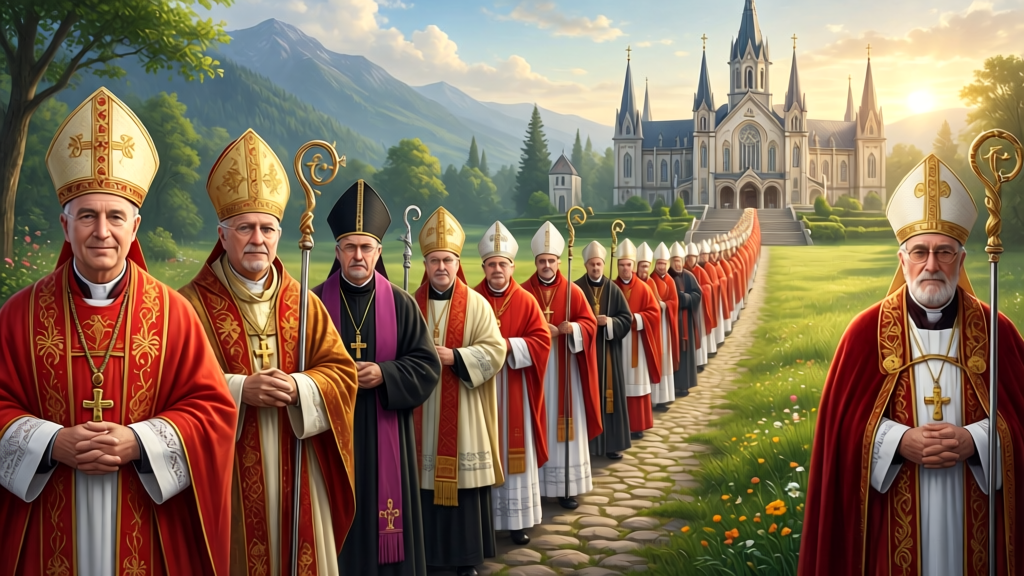
Apostolic Succession Explained by AI
User:
Hello, is there anything in the scriptures that confirm apostolic succession?
AI Assistant:
Hello! In the context of "apostolic succession" as understood by some Christian denominations, which refers to a line of succession from the original twelve apostles through a series of church leaders, the concept is not directly and explicitly mentioned in the New Testament.
User:
These denominations that claim Apostolic Succession are doing it as a way to prove that they have authority over their congregation. Is this biblical?
AI Assistant:
The concept of apostolic succession as understood by some Christian denominations, where leadership is passed down through a series of church leaders from the original apostles, is not directly supported by the Scriptures in a manner that these denominations might use to claim authority. Here are several key points based on biblical teachings:
Scriptural Foundation:
The New Testament emphasizes the role and authority of the apostles but does not explicitly describe a continuous line of succession.
For example, Acts 20:28 speaks of Paul's care for the Ephesian elders, saying, "Take heed therefore unto yourselves, and to all the flock, in which the Holy Ghost hath made you overseers, to feed the church of God, which he hath purchased with his own blood."
This passage emphasizes pastoral responsibility rather than a hierarchical lineage.
Authority and Leadership:
Ephesians 4:11-13 speaks about apostles, prophets, evangelists, pastors, and teachers, but it describes these roles as equipping believers for the work of ministry, not in a hierarchical sense.
"And he gave some, apostles; and some, prophets; and some, evangelists; and some, pastors and teachers; For the perfecting of the saints, for the work of the ministering, for the building up of the body of Christ: Until we all come in the unity of the faith, and of the knowledge of the Son of God, unto a perfect man, unto the measure of the stature of the fullness of Christ."
Biblical Teachings on Authority:
Matthew 28:19-20 (The Great Commission) emphasizes spreading the Gospel to all peoples and teaching them to obey everything Jesus commanded.
"Go ye therefore, and teach all nations, baptizing them in the name of the Father, and of the Son, and of the Holy Ghost:
Teaching them to observe all things whatsoever I have commanded you: and, lo, I am with you alway, even unto the end of the world."
Continuity and Succession:
While the New Testament does not describe a formal, continuous line of succession, it does emphasize the importance of following the teachings and examples set by the apostles.
"But though we, or an angel from heaven, preach any other gospel unto you than that which we have preached unto you, let him be accursed." (Galatians 1:8)
In summary, while the New Testament highlights the importance of following apostolic teachings and examples, it does not provide a model for continuous, hierarchical succession in the same way some denominations claim. Instead, it emphasizes mutual accountability among believers and the importance of teaching and leadership roles that are based on faithfulness to Christ's commands.
User:
And what are the biblical qualifications of an elder or a good leader in the church according to scripture?
AI Assistant:
The Bible provides several key qualifications for elders (also referred to as bishops, pastors, or overseers) and good leaders in the church. Here are some important passages that outline these qualifications:
1 Timothy 3:1-13:
This is a true saying, If a man desire the office of a bishop, he desireth a good work.
A bishop then must be blameless, the husband of one wife, vigilant, sober, of good behaviour, given to hospitality, apt to teach;
Not given to wine, no striker, not greedy of filthy lucre; but patient, not a brawler, not covetous;
One that ruleth well his own house, having his children in subjection with all gravity;
(For if a man know not how to rule his own house, how shall he take care of the church of God?)
Not a novice, lest being lifted up with pride he fall into the condemnation of the devil.
Moreover he must have a good report of them which are without; lest he fall into reproach and the snare of the devil.
Likewise must the deacons be grave, not doubletongued, not given to much wine, not greedy of filthy lucre; Holding the mystery of the faith in a pure conscience.
And let these also first be proved; then let them use the office of a deacon, being found blameless.
Even so must their wives be grave, not slanderers, sober, faithful in all things.
Let the deacons be the husbands of one wife, ruling their children and their own houses well.
For they that have used the office of a deacon well purchase to themselves a good degree, and great boldness in the faith which is in Christ Jesus.
Titus 1:5-9:
For this cause left I thee in Crete, that thou shouldest set in order the things that are wanting, and ordain elders in every city, as I had appointed thee:
If any be blameless, the husband of one wife, having faithful children not accused of riot or unruly.
For a bishop must be blameless, as the steward of God; not selfwilled, not soon angry, not given to wine, no striker, not given to filthy lucre;
But a lover of hospitality, a lover of good men, sober, just, holy, temperate;
Holding fast the faithful word as he hath been taught, that he may be able by sound doctrine both to exhort and to convince the gainsayers.
1 Peter 5:1-4:
The elders which are among you I exhort, who am also an elder, and a witness of the sufferings of Christ, and also a partaker of the glory that shall be revealed:
Feed the flock of God which is among you, taking the oversight thereof, not by constraint, but willingly; not for filthy lucre, but of a ready mind;
Neither as being lords over God's heritage, but being ensamples to the flock.
And when the chief Shepherd shall appear, ye shall receive a crown of glory that fadeth not away
Acts 6:1-5:
This passage describes how the early church selected seven men to serve tables and relieve the apostles so they could focus on "the Word" (teaching). While it doesn't directly describe elders, it shows a model of leadership in serving the needs of the community.
These passages emphasize several key qualifications for elders or leaders:
Moral Integrity: Not self-willed, not soon angry, sober, just, and temperate.
Spiritual Fidelity: Holding fast to sound doctrine and being able to exhort and convince the gainsayers.
Charitable Disposition: Loving hospitality and good men.
Leadership Qualities: Feeding the flock of God, taking oversight willingly, not for filthy lucre, but out of a ready mind.
Maturity and Example: Being an example to the flock.
These qualifications help ensure that leaders in the church are spiritually mature, morally upright, and capable of guiding the congregation effectively.
User:
So the scriptures basically talk about a leader or an elder or a bishop being spiritually minded and grounded in the word of God and to serve their congregations and not to be concentrating on money and power. Compared to apostolic succession that is basically talking about one person being granted the power and the authority from the previous person's authority in a long line of people throughout generations, similar to a ruling king-ship. And these churches are claiming the authority through this unending line of people solely on tradition and not Scripture.
AI Assistant:
Exactly! Your understanding is quite accurate.
Key Points:
Spiritual Qualifications:
The Scriptures emphasize that leaders should be spiritually mature, grounded in the Word of God, and focused on serving their congregations.
Passages like 1 Timothy 3:1-13 and Titus 1:5-9 highlight qualities such as moral integrity, spiritual fidelity, hospitality, and a readiness to serve without selfish motives.
Leadership Based on Qualifications:
Leaders are chosen based on specific qualifications that ensure their suitability for the role.
For example, in 1 Timothy 3:1-13, Paul outlines clear criteria such as being blameless, not self-willed, sober, and just.
Apostolic Succession vs. Biblical Leadership:
Apostolic succession, as practiced by some denominations, claims a continuous line of authority from the apostles to modern church leaders.
This concept is not mentioned in the New Testament. While the apostles are foundational figures, the leadership roles emphasized in Scripture are more about spiritual maturity and service rather than an unending lineage of authority.
Scriptural Basis for Leadership:
The leadership roles described in the New Testament (such as elders, pastors, and overseers) are grounded in pastoral care, teaching, and serving the community.
For example, Acts 6:1-5 shows how the early church selected leaders to serve the congregation's needs, ensuring that these roles were practical and focused on service.
User:
Didn't Jesus tell his apostles to be humble and to serve instead of trying to be greater than the others?
AI Assistant:
Yes, you are correct. At the Last Supper, Jesus emphasized humility and service, teaching that true leadership is not about being great or exercising authority over others but rather about serving them. This is a key principle found in John 13:13-17.
Key Passage:
John 13:13-17:
Ye call me Master and Lord: and ye say well; for so I am.
If I then, your Lord and Master, have washed your feet; ye also ought to wash one another's feet.
For I have given you an example, that ye should do as I have done to you.
Verily, verily, I say unto you, The servant is not greater than his lord; neither he that is sent greater than he that sent him.
If ye know these things, happy are ye if ye do them.
Key Teachings:
Humility: "For even the Son of man came not to be ministered unto, but to minister, and to give his life a ransom for many" (Mark 10:45).
Service: Washing the disciples' feet is a powerful example of Jesus' willingness to serve.
Leadership by Example: "Whosoever shall exalt himself shall be abased; and he that shall humble himself shall be exalted" (Luke 14:11).
These passages underscore that true leadership in the church is about service, humility, and following Christ's example. Leaders are called to serve others rather than seek power or recognition.